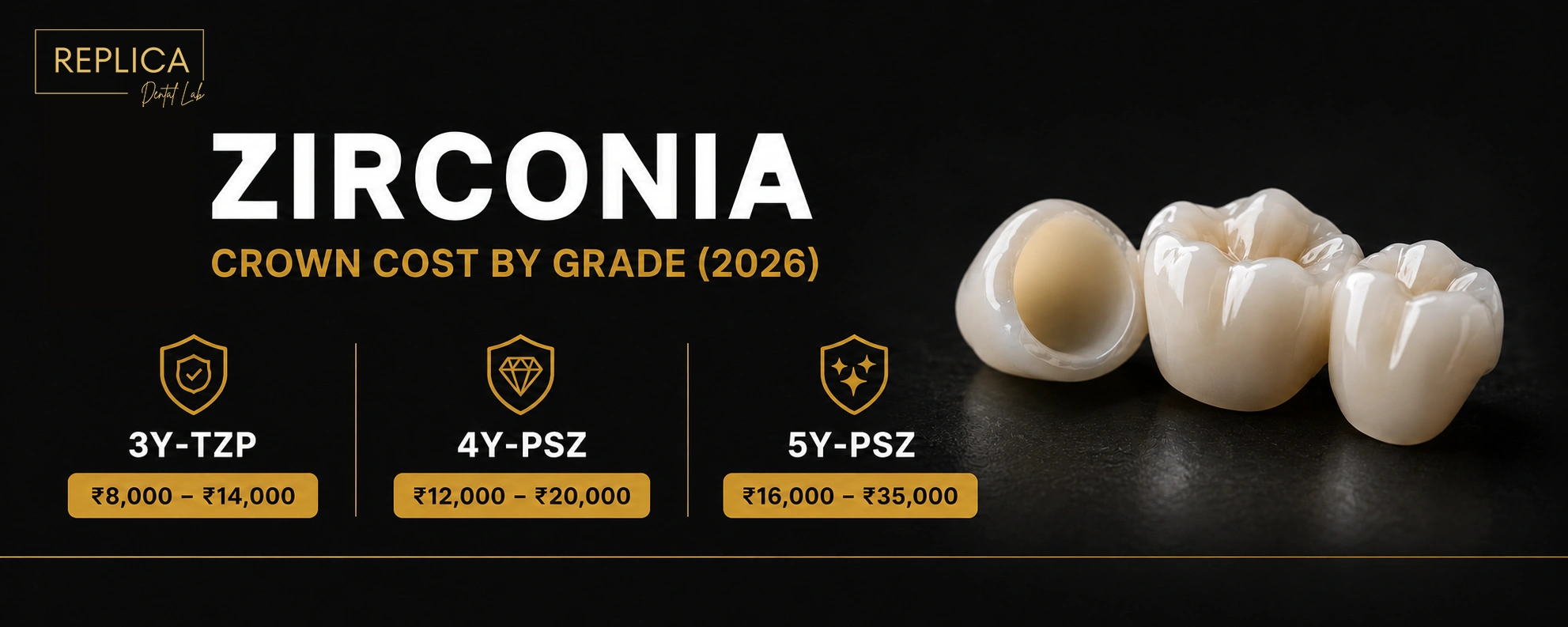

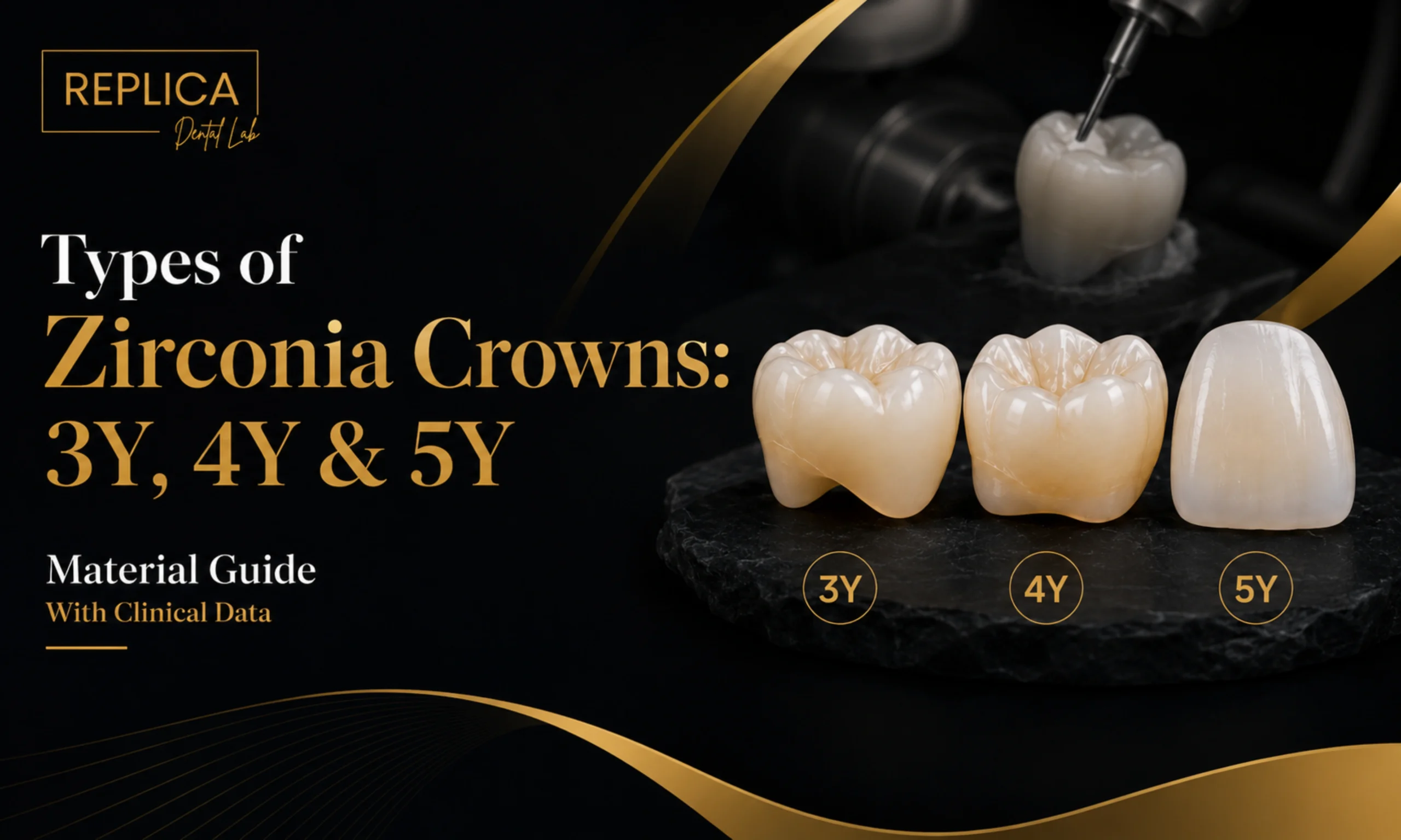
Every zirconia crown starts as the same base ceramic – zirconium dioxide stabilized with yttrium oxide (yttria). What changes between types is the amount of yttria added, and that single variable controls two properties that pull in opposite directions: strength and translucency. More yttria increases the cubic phase of the crystal structure, which improves light transmission but reduces the tetragonal phase responsible for the material’s fracture resistance, a mechanism known as transformation toughening.
This trade-off is why “zirconia crown” isn’t one product. It’s a family of materials – 3Y, 4Y, and 5Y-stabilized zirconia – each suited to a different clinical situation, plus a fabrication choice (monolithic vs. layered) that further affects how each one performs in the mouth.
3Y-TZP: The First-Generation, High-Strength Zirconia
3Y-TZP (3 mol% yttria-stabilised tetragonal zirconia polycrystal) was the original dental zirconia and remains the strongest. Independent testing has recorded flexural strength for 3Y-TZP as high as 1,133 MPa in fully sintered specimens, and other studies place first-generation 3Y-TZP flexural strength consistently above 1,350 MPa.
The trade-off is opacity. 3Y-TZP is noticeably more opaque than natural enamel and dentin, which historically meant it had to be veneered with porcelain to look acceptable in the smile zone – a layering step that introduced its own risk of chipping.
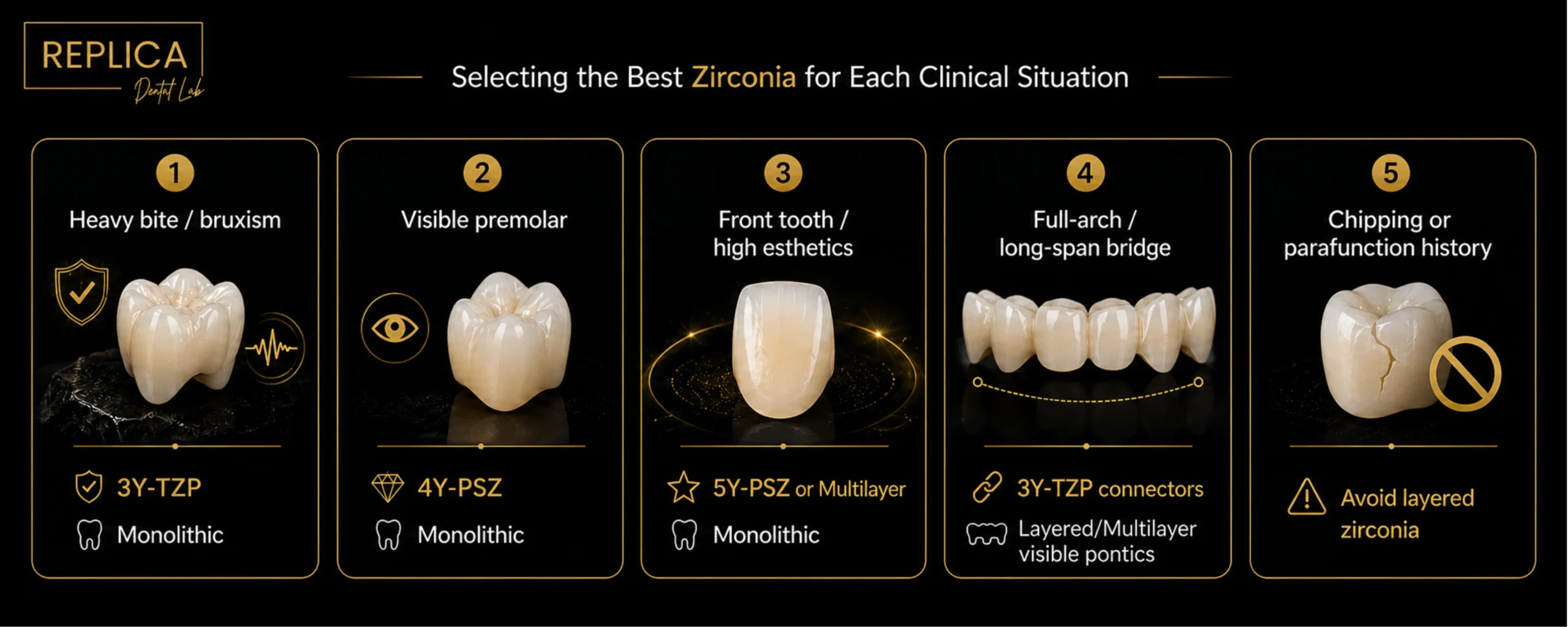
Best suited for: molars, bruxism cases, long-span bridges, and any situation where mechanical load outweighs the need for translucency.
4Y-PSZ: The Balanced, Second-Generation Zirconia
4Y-PSZ (4 mol% yttria-partially stabilized zirconia) sits deliberately between 3Y and 5Y. It was developed specifically to close the gap between 3Y-TZP’s strength and 5Y-PSZ’s esthetics, and research shows it succeeds at that goal – 4Y-PSZ delivers noticeably better esthetic outcomes than 3Y-TZP even in its more opaque dentin layer, while retaining meaningfully more strength than 5Y-PSZ, according to a 2025 flexural strength comparison across multilayer zirconia systems.
This makes 4Y-PSZ the practical middle ground rather than a compromise – it’s frequently the default choice when a single crown needs to handle both function and visibility, such as premolars.
Best suited for: premolars, general single-unit crowns, and cases where the tooth is visible but not in the direct esthetic zone.
5Y-PSZ: The High-Translucency, Third-Generation Zirconia
5Y-PSZ (5 mol% yttria-partially stabilised zirconia) was developed to make monolithic anterior restorations possible without a porcelain layer. The added yttria increases the cubic phase substantially, which is what gives 5Y-PSZ its glass-like appearance – but it comes at a real mechanical cost.
Flexural strength for 5Y-PSZ typically falls between 600 and 800 MPa, roughly 40–50% lower than 3Y-TZP, with a fracture toughness of approximately 2–3 MPa·m⁰·⁵ versus 4–5 MPa·m⁰·⁵ for 3Y-TZP. This range is still considered clinically acceptable for anterior use, where occlusal load is lower, but it’s the reason 5Y-PSZ is not recommended as a first choice for molars.
Best suited for: anterior crowns and veneer-adjacent restorations where esthetics is the primary clinical requirement.
Multilayer Zirconia: Combining Grades in One Disc
Multilayer (or “multi-shaded”) zirconia discs are a manufacturing response to the strength-translucency trade-off, not a fourth material grade. A single disc is graded through its thickness – higher-strength composition near the gingival/dentin layer, higher-translucency composition near the incisal edge – so one milled crown carries both properties across its structure. Commercial systems built on this concept are compared directly in recent multilayer flexural strength testing, which found strength varies meaningfully by layer position within the same disc, not just by brand.
This is different from a layered crown, where a porcelain veneer is fused over a zirconia coping – an older technique still used for maximum esthetic control, but one that clinical data consistently shows carries a higher chipping risk than monolithic designs.
Monolithic vs. Layered Zirconia: What the Long-Term Data Shows
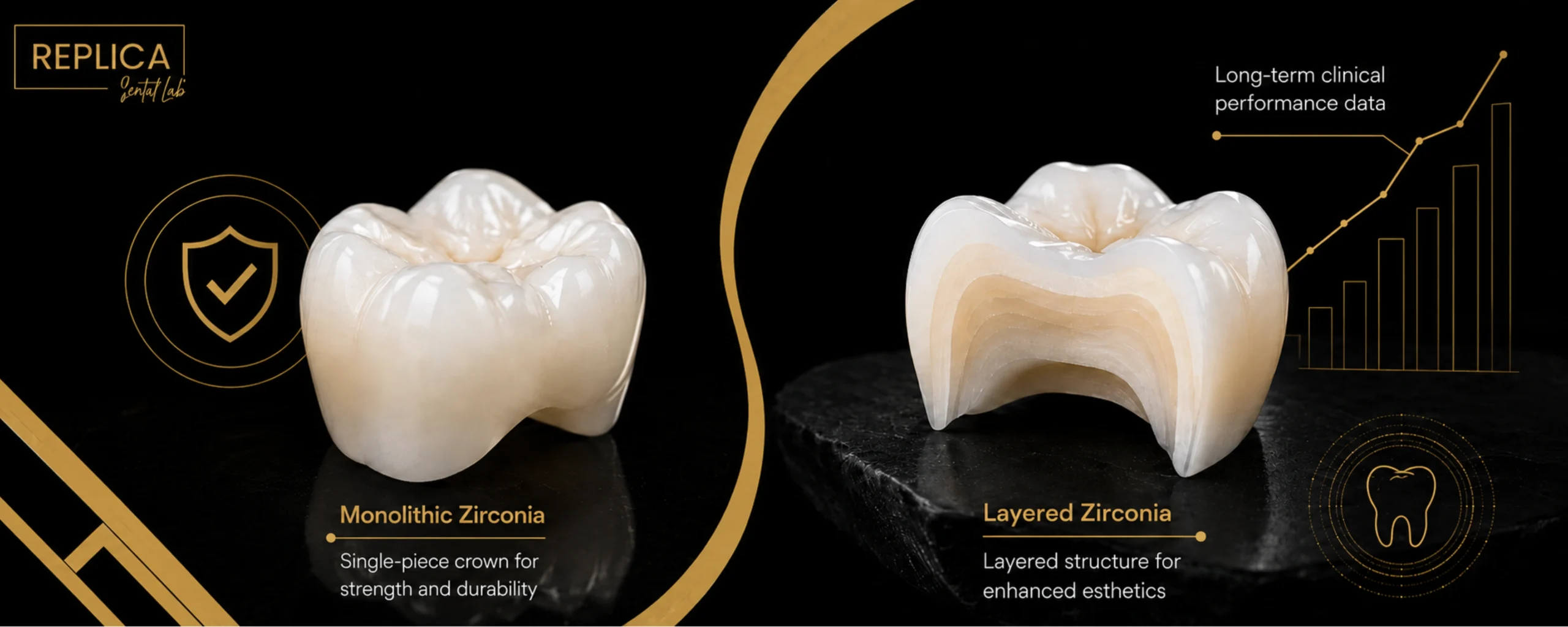
This is the comparison with the strongest clinical – not just lab-bench – evidence behind it.
A 2025 retrospective cohort study following 255 posterior crowns over 10 years found monolithic zirconia crowns reached an 86.0% survival rate, compared with 71.0% for porcelain-layered zirconia crowns over the same period, with the layered group failing more often due to porcelain chipping (The Journal of Prosthetic Dentistry, 2025).
A separate five-year comparative study reported an even wider gap at the material level: monolithic zirconia restorations achieved a 100% survival rate, while layered restorations reached 95.8%, with nearly all layered failures traced to chipping of unsupported porcelain over 1.5 mm thick (PMC, 2024).
A broader systematic review pooling data through 2024 placed five-year survival at 96.8% for monolithic densely-sintered zirconia versus 97.3% for veneered zirconia – statistically comparable at five years, but the gap widens as the follow-up period extends toward ten years (PubMed, 2026).
The pattern across all three data sets is consistent: layering adds esthetic control but also adds a failure mode – chipping – that monolithic designs largely avoid. This is why monolithic zirconia has become the default recommendation for most single-crown cases, reserving layered techniques for situations where esthetic demand genuinely outweighs the added mechanical risk.