

Opening a dental clinic is one of the biggest professional decisions a dentist makes – bigger, in most cases, than any single treatment plan you’ll ever write. It sits at the intersection of clinical skill, business planning, and regulatory compliance, and getting any one of those wrong can delay your launch by months or quietly erode your margins for years.
Every year, thousands of BDS and MDS graduates across India move from associate roles into clinic ownership. Most of them are excellent clinicians. Far fewer have been trained to think like operators – to plan cash flow, negotiate a lease, or evaluate a lab partner.
The Dental Clinic Setup Checklist: 10 Steps to Get Right
The steps below follow the order most dentists actually move through when opening a clinic — from the first financial projections to the day you open your doors. Some can run in parallel, but each one influences the decisions that come after it, so treat the sequence as a guide rather than a rigid rulebook.
1. Start With a Real Business Plan, Not Just a Location
Before you sign a single lease, put numbers on paper. A dental clinic business plan should cover:
- Capital requirement – typically ₹15–40 lakhs for a single-chair clinic in a Tier-1 city, and ₹8–20 lakhs in smaller towns, depending on equipment quality and interiors.
- Break-even timeline – most new clinics take 12–18 months to reach a stable patient base; plan your working capital accordingly.
- Service mix – general dentistry, orthodontics, implants, cosmetic dentistry, or a combination. This decision shapes your equipment list, staffing, and lab requirements later.
- Target patient volume – realistic daily footfall projections based on your catchment area, not aspirational ones.
A clinic built around a written plan is far less likely to run out of runway in its first year than one built around a good location alone.
2. Get Your Legal and Regulatory Registrations in Order
India’s dental clinics operate under a layered set of central, state, and municipal regulations. Missing even one can hold up your inauguration or invite penalties later. Your checklist should include:
- Dental Council registration – your personal registration with the State Dental Council must be current, and if you’re bringing on associates, theirs must be verified too.
- Clinical Establishment Act registration – mandatory in states that have adopted the Act; check your specific state’s requirements, as implementation varies.
- Shop and Establishment license from the local municipal corporation.
- Biomedical Waste Management authorisation under the Bio-Medical Waste Management Rules, along with a contract with an authorised waste disposal agency.
- Fire safety and pollution control clearances, particularly if you’re installing an X-ray unit — this includes having ISI-marked portable fire extinguishers installed at points specified by your local fire department, along with valid inspection and refill records.
- GST registration, since most dental services and lab-sourced prosthetics attract GST, and you’ll need to invoice correctly from day one.
- Radiation safety license (AERB approval) for any intraoral or panoramic X-ray equipment – this is often the most time-consuming approval, so start it early.
Build a two-to-three month buffer into your timeline purely for approvals. Regulatory delays are the single most common reason clinic launches slip.
3. Choose and Plan Your Clinic Space
Location decisions in dentistry are as much about workflow as footfall. When evaluating a space, look at:
- Catchment demographics – residential density, nearby offices, schools, and existing dental competition.
- Carpet area and layout – a single-chair clinic typically needs 300–500 sq. ft.; multi-chair setups need proportionally more, plus a separate sterilization zone.
- Plumbing and electrical load – dental chairs, autoclaves, and X-ray units have specific power and water requirements that not every commercial space is pre-fitted for.
- Accessibility and parking – especially relevant if you expect a meaningful share of elderly or family patients.
Get an interior designer or contractor experienced specifically with dental clinics, not general retail fit-outs – the workflow between reception, operatory, and sterilization areas affects both patient experience and infection control compliance.
4. Build Your Equipment and Instrument List
This is where capital planning gets granular. A core equipment checklist typically includes:
- Dental chair and delivery unit
- Autoclave and sterilisation equipment
- Intraoral or OPG X-ray unit
- Consumables — gloves, disposables, restorative materials
- Portable fire extinguishers placed near the operatory, sterilisation area, and reception, matched to the fire class relevant to your equipment and electrical load
- An intraoral scanner, if you’re planning a digital workflow from the outset
That last point deserves attention. Dentists who invest in an intraoral scanner early – rather than retrofitting one a few years in – tend to have a smoother transition into digital case submission, faster turnaround on prosthetics, and fewer remakes due to impression errors. If you’re weighing this decision, it’s worth reading about what a digital workflow means for clear aligner cases before you finalise your scanner and case-submission process.
5. Recruit Your Clinical and Support Team
Even a solo-practitioner clinic needs support staff. Plan your hiring around:
- A trained dental assistant for chairside support and sterilization protocols
- A front-desk executive for scheduling and billing
- A part-time or on-call hygienist, if your service mix includes preventive care
- Visiting specialists (orthodontist, endodontist, periodontist) if you plan to offer multi-speciality services without full-time hires
Define standard operating procedures for infection control, patient records, and case documentation before your first patient walks in – retrofitting protocols after you’re operational is disruptive.
6. Choose the Right Dental Lab Partner Before You Open, Not After
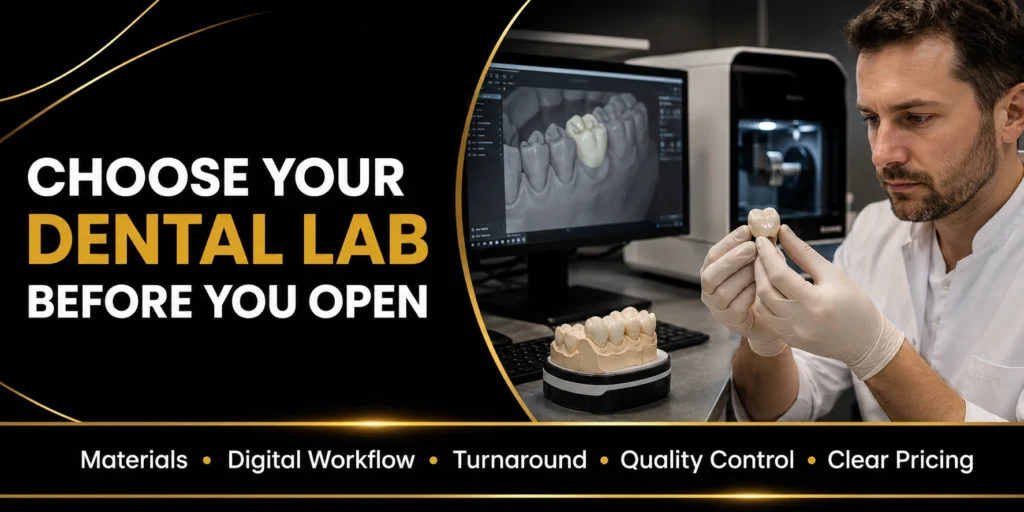
This is the step new clinic owners most often defer – and the one that has the most direct impact on patient outcomes and chair-time efficiency. Every crown, bridge, denture, or aligner you prescribe depends on the lab behind it. A lab with inconsistent margins or unpredictable turnaround times will cost you far more in remakes and rescheduled appointments than you’ll ever save on a lower price per unit.
When evaluating a dental lab partner as part of your clinic setup, look at the same criteria you’d apply to any long-term vendor relationship:
- Material transparency – does the lab tell you exactly what grade of zirconia or ceramic you’re getting, and can they explain why one material suits a given case over another? Understanding the different zirconia grades and their clinical applications upfront will help you brief your lab correctly and avoid mismatched cases.
- Digital workflow compatibility – a lab that accepts STL files directly from major intraoral scanners (3Shape, iTero, Medit, and others) removes a significant amount of friction from your day-to-day case submission.
- Turnaround consistency – ask for real delivery timelines, not best-case estimates, and check whether they hold to them across both simple and complex cases.
- Quality control process – a lab that inspects cases at multiple stages, from prescription verification through pre-dispatch, will send you fewer cases that need chairside adjustment.
- Pricing clarity – get a full breakdown before you commit, especially for zirconia and implant-related work, where pricing can vary significantly by grade and city.
Replica Dental works with dentists across India on exactly this basis – a fully digital, CAD/CAM-driven workflow covering zirconia and IPS Emax crowns, PFM crowns, implant prosthetics, dentures, orthodontic appliances, and clear aligners, backed by a four-step quality check before any case leaves the lab. If you’re finalizing your lab relationships as part of your clinic setup, it’s worth uploading a scan file for your first case before opening day, so your workflow is tested and your turnaround expectations are set before real patients are on your schedule.
7. Plan Your Implant and Prosthetic Case Workflow Early
If implants are part of your planned service mix, this deserves its own line item in your setup checklist. Implant cases involve more coordination between clinician and lab than a standard crown – abutment selection, screw- versus cement-retention, and prosthetic design all need to be planned before you place your first fixture. Reviewing the benefits, procedure & typical cost structure of custom implant prosthetics in Indiabefore you open is a useful way to set both your clinical protocols and your patient pricing conversations correctly from the start, rather than adjusting them mid-case.
8. Set Up Practice Management and Patient Records
Choose a practice management system before opening day, not after your appointment book fills up. At minimum, it should handle:
- Appointment scheduling and reminders
- Digital patient records and treatment history
- Billing and GST-compliant invoicing
- Case tracking for lab-dependent treatments, so you always know where a crown, denture, or aligner set stands in production
9. Plan Your Marketing and Patient Acquisition
A clinical setup is only half the launch. Before opening:
- Register your clinic on Google Business Profile and relevant local directories
- Build a simple, informative website or landing page
- Set up before-and-after documentation protocols for cosmetic and orthodontic cases (with patient consent) – this becomes valuable marketing material later
- Plan a soft-launch period with introductory offers for your immediate catchment area
10. Build a Financial Cushion for the First Year
Even well-planned clinics rarely hit full capacity in month one. Keep 6–9 months of operating expenses – rent, salaries, EMIs, and consumables – set aside separately from your setup capital. This buffer is what lets you make sound clinical and business decisions in year one instead of reactive ones driven by cash flow pressure.
Conclusion
Setting up a dental clinic in India is a sequence of interconnected decisions – legal compliance, space planning, equipment investment, team building, and vendor relationships – and each one affects the others.
The clinics that open smoothly and scale well are rarely the ones with the biggest budgets; they’re the ones where the founding dentist treated setup with the same rigor as a treatment plan: assess, sequence, and execute in the right order.
Your lab partnership deserves the same early attention as your lease or your equipment list. A dependable, digitally integrated lab reduces remakes, protects chair time, and lets you commit to case timelines with confidence from your very first week in practice.